Publications
The Africa Roundtable N°9
Handlungsempfehlungen
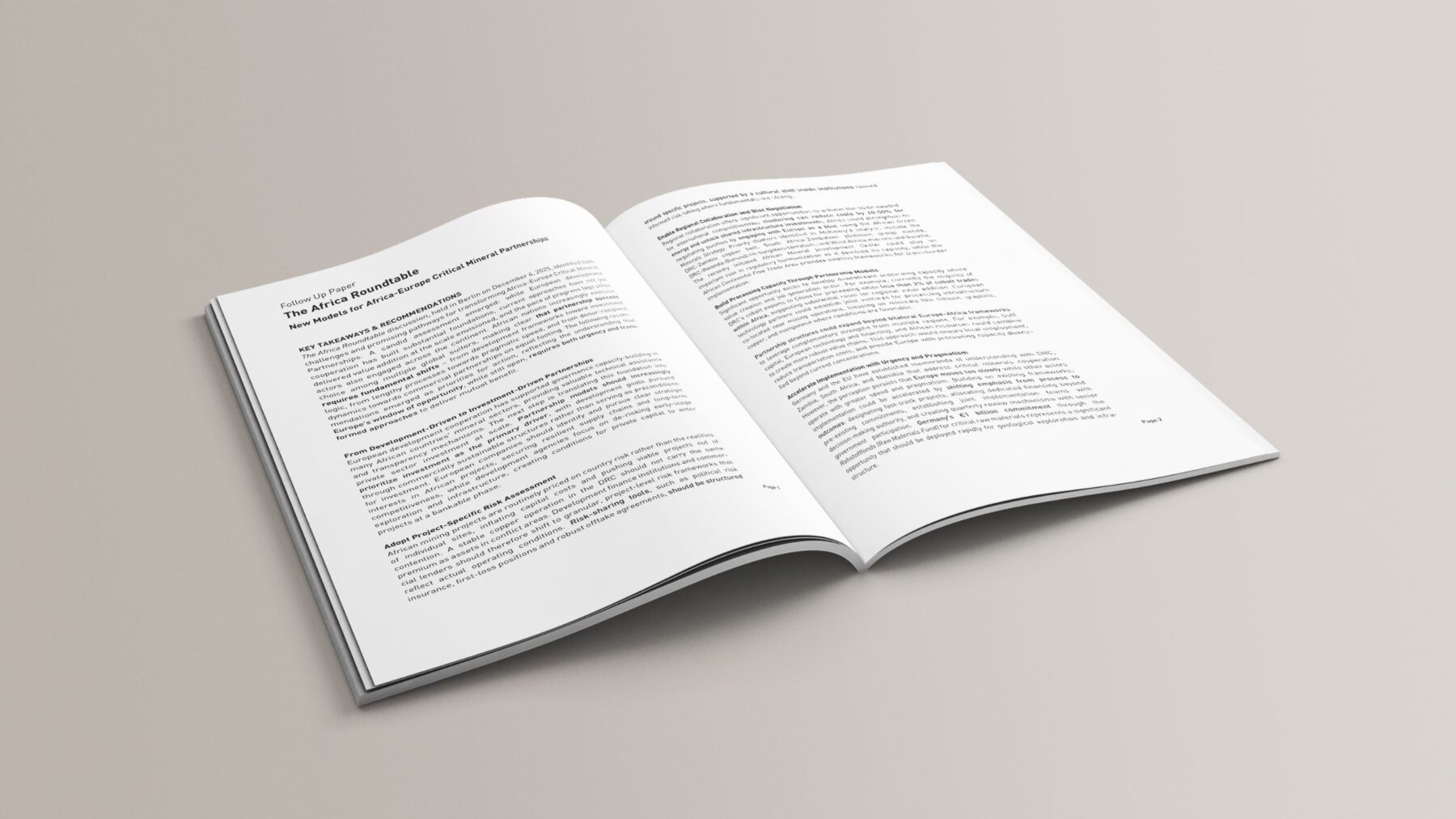
The Africa Roundtable in Berlin 2025
New Models for Africa-Europe Critical Mineral Partnerships
Publications: The Africa Roundtable N°9
December 17, 2025
Berlin
The 9th edition of The Africa Roundtable, held in Berlin, identified both the challenges and opportunities in transforming Africa-Europe critical mineral partnerships. The message was clear: Europe’s window of opportunity, though still open, demands urgency and innovative approaches to generate mutual benefits.
Africa holds extraordinary mineral wealth essential to the global energy transition. The discussions explored new partnership models that could deliver value creation for both continents. Decision-makers from Germany, Europe, and Africa emphasized that achieving shared prosperity requires building on existing strengths and moving from aspiration to pragmatic action that delivers tangible outcomes.
Drawing from previous discussions on green finance, infrastructure, and training, this edition focused on bridging the gap between ambitious partnerships and tangible results. The focus was on creating tangible value through manufacturing, job creation, and economic development, moving beyond mere raw material extraction and traditional development cooperation.
Action Recommendations
Investment-Driven Partnerships
European development cooperation has supported governance in African mineral sectors through technical assistance and transparency. The next step is to translate this foundation into large-scale private investment, prioritizing sustainable partnerships. Agencies should de-risk the early stages, and companies should pursue strategic projects.
Project-Specific Risk Assessment
African mining projects are often priced on country risk, inflating costs and sidelining viable assets. To address this issue, lenders should adopt project-level risk assessments and structure risk-sharing tools around actual conditions. This approach should be supported by informed risk-taking where fundamentals are strong.
Regional Collaboration
Regional collaboration can increase competitiveness and reduce energy costs by 40–50% through clustering and shared infrastructure. Supported by the African Mineral Development Center and the African Continental Free Trade Area, engaging Europe as a bloc can strengthen Africa’s position across priority mineral clusters.
Partnership Models
There is significant potential for expanding downstream processing, which creates value and jobs. Multi-region partnerships combining African resources, European technology, and Gulf capital could establish local processing, reduce costs, and diversify Europe’s supply chains.
Urgency and Pragmatism
Germany and the EU have established memoranda of understanding on critical minerals with several African countries, but implementation is seen as too slow. To accelerate delivery, they need fast-track projects, dedicated financing, empowered joint teams, regular reviews, and the rapid deployment of Germany’s €1 billion Rohstofffonds.
Financing Instruments
Germany has developed several financing tools for critical minerals, but better coordination could amplify their impact. Integrated packages that combine exploration grants, risk insurance, commercial debt, and trade credits could reduce the risk in the early stages, particularly geological exploration, and attract private capital.
Competitiveness and Market Dynamics
Long-term success requires cost-competitive mining and processing in Africa. Priorities include reducing energy costs, correcting mispricing through strategic mechanisms, taking a long-term approach, and investing in shared infrastructure to support private mining activity.
Contact Persons
Stephanie Igunbor, s.igunbor@globalperspectives.org
Supported by
BMZ Bundesministerium für wirtschaftliche Zusammenarbeit und Entwicklung
BDI Bundesverband der Deutschen Industrie
GIZ Deutsche Gesellschaft für internationale Zusammenarbeit
Publications
Our collaborative publications aim to stimulate questioning and discussion. They are the result of a deep engagement with the focus topics of our work and enable a fact-based dialogue.
Related Program
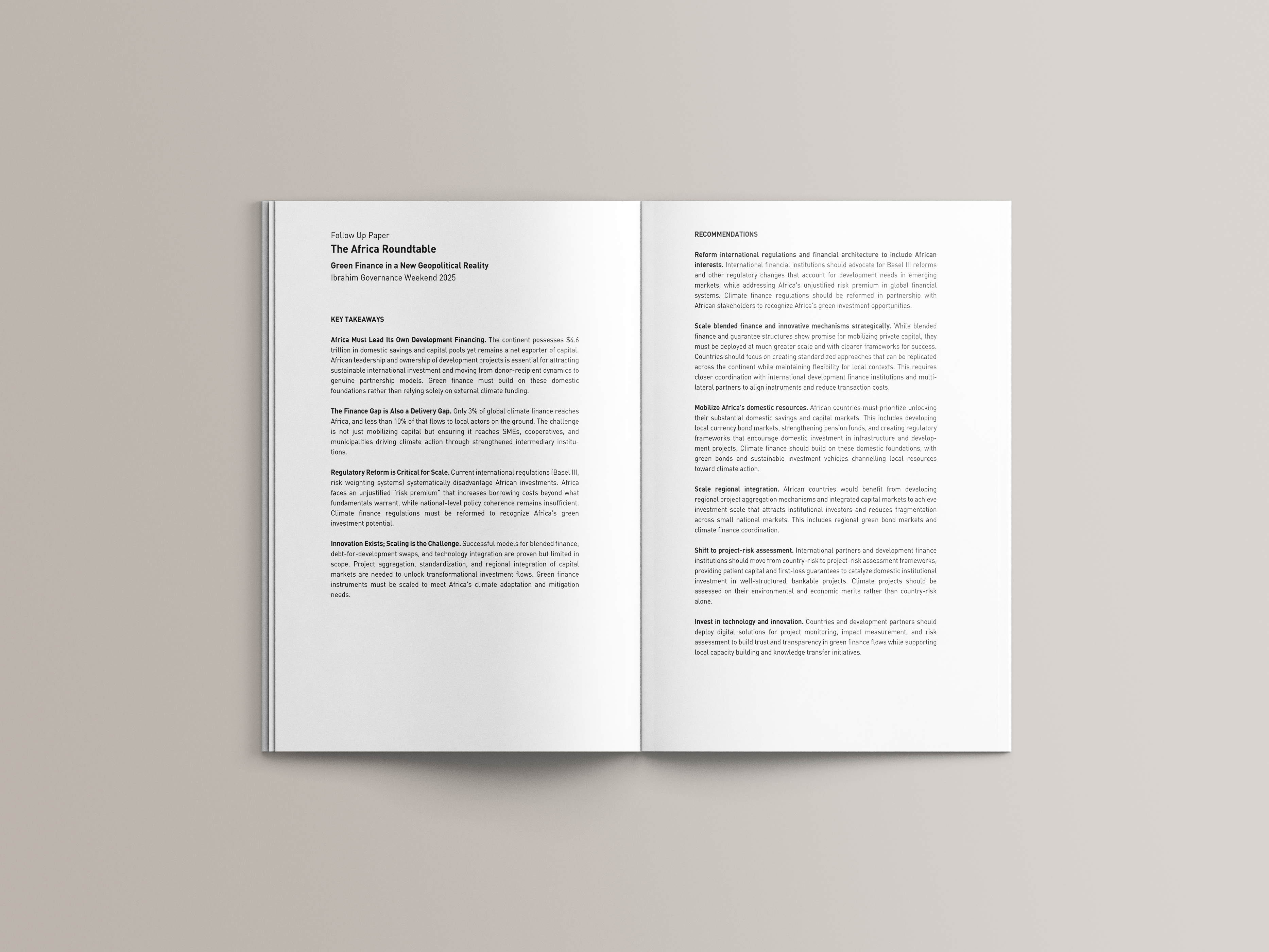
Amid shifting global dynamics, investing in Africa’s strengths in renewable energy and climate action is more urgent than ever. The action recommendations of the eighth conference.

With data emerging as the key driver of future economic power, Africa's digital transformation is critical and urgent. The action recommendations of the seventh conference.

The African continent has the potential to become the global agriculture powerhouse. The action recommendations of the sixth conference.

The research paper on new technologies and innovation in the African agricultural sector was issued on the occasion of The Africa Roundtable “Growing Africa's Future” 2024 in Berlin.

The research paper on food sovereignity in Africa was issued on the occasion of The Africa Roundtable “Growing Africa's Future” 2024 in Berlin.

Strategies for education, skill building and the labor market of tomorrow. The action recommendations of the fifth conference.

The research paper on education and training in Africa was issued on the occasion of The Africa Roundtable “The Path to Success: Education, Skills, and Leadership” 2023 in Berlin.

We are at a turning point in European-African economic relations. The action recommendations of the fourth conference.
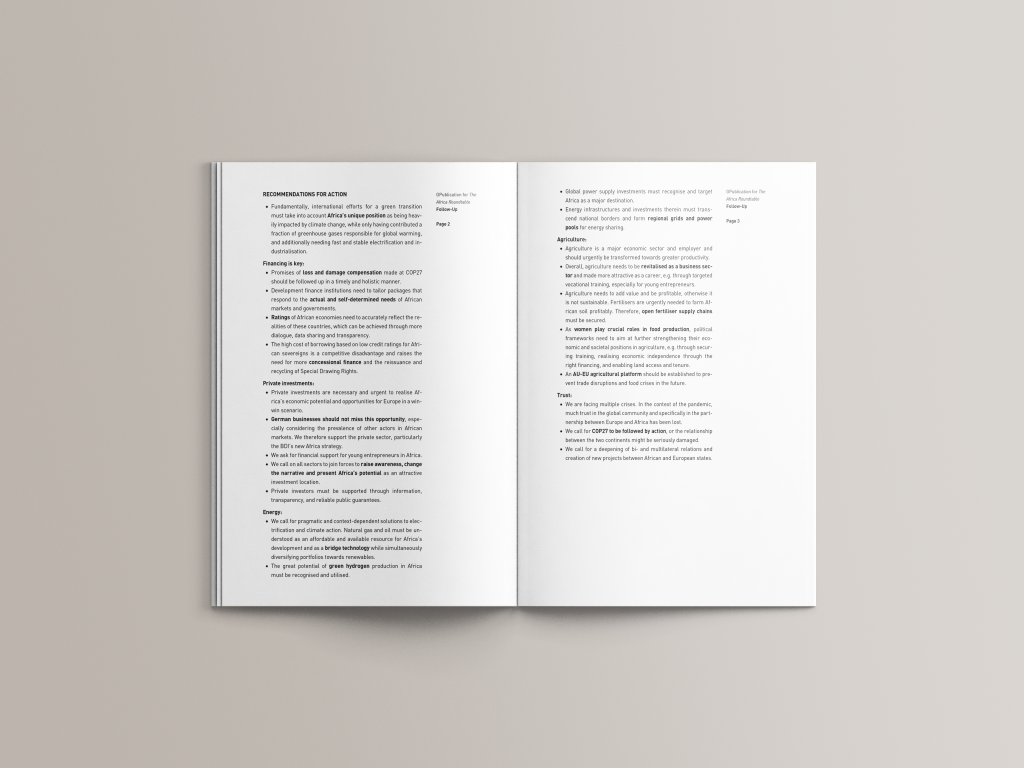
Following COP27, decision-makers from both continents discussed collaborative action plans for a just green transition, energy and agriculture.
Program Archive
In the ninth edition of the Africa Roundtable, we discussed how Europe and Africa build partnerships that turn Africa's raw material wealth into local value creation.
This paper explores how Africa can add value to its critical minerals, boost local processing, and drive green industrialization while strengthening regional and global supply chains.
We discussed with State Secretary Niels Annen how development policy can be integrated into networked foreign, security, and economic policies.
US tariffs changes are causing new uncertainties in global trade. Together with ONE and Pinelopi K. Goldberg, we discussed how international development policy needs to be realigned.
As traditional trade relations shift, strengthening local value chains, enhancing trade agreements, and mobilizing private capital are key to building more resilient and mutually beneficial economies.
Our speaker James Irungu Mwangi shared his perspective on how to accelerate climate action and investment across Africa. Together, we discussed what it will take to mobilize the green finance needed.
Germany is a country of immigration. Building on our Commission's recommendations for action, we discussed ways to better manage and communicate labor migration.
Europe and Africa have the chance to advance technology and shape the future of the global space economy together through cooperation.
Amid shifting global dynamics, investing in Africa’s strengths in renewable energy and climate action is more urgent than ever. The action recommendations of the eighth conference.